Thursday, 15 February 2024

addition and subtraction of unsigned and signed numbers

The direct method of subtraction taught in elementary schools uses the borrow concept. In this method we borrow a 1 from a higher significant position when the minuend digit is smaller than the corresponding subtrahend digit. This seems to be easiest when people perform subtraction with paper and pencil. When subtraction is implemented with digital hardware, this method is found to be less efficient than the method that uses complements.

The subtraction of two n-digit unsigned numbers M - N (N * 0) in base r can be done as follows:

1. Add the minuend M to the r's complement of the subtrahend N. This performs M + (r' - N) = M - N + r'.

2. If M "" N, the sum will produce an end carry r' which is discarded, and what is left is the result M - N.

3. If M < N, the sum does not produce an end carry and is equal to r' - (N - M), which is the r's complement of (N - M). To obtain the answer in a familiar form, take the r' s complement of the sum and place a negative sign in front.

Consider, for example, the subtraction 72532 - 13250 = 59282. The lO's complement of 13250 is 86750. Therefore:

M = 72532

lO's complement of N = +86750

Sum = 159282

Discard end carry 10' = -100000

Answer = 59282

Now consider an example with M < N. The subtraction 13250 - 72532 produces negative 59282. Using the procedure with complements, we have

M = 13250

lO's complement of N = +27468

Sum = 40718

There is no end carry.

Answer is negative 59282 = 10's complement of 40718

Since we are dealing with unsigned numbers, there is really no way to get an unsigned result for the second example. When working with paper and pencil, we recognize that the answer must be changed to a signed negative number. When subtracting with complements, the negative answer is recognized by the absence of the end carry and the complemented result.

Subtraction with complements is done with binary numbers in a similar manner using the same procedure outlined above. Using the two binary numbers X = 1010100 and Y = 1000011, we perform the subtraction X - Y and Y - X using 2's complemenfs:

X= 1010100

2' s complement of Y = +0111101

Sum = 10010001

Discard end carry 27 = - 10000000

Answer: X - Y = 0010001

y = 1000011

2's complement of X = +0101 100

Sum = 1101111

There is no end carry

Answer is negative 0010001 = 2's complement of 1101111

Signed and Unsigned Binary Numbers

 Understanding Number Representation Techniques

  1. Integers can be represented in signed and unsigned ways.
  2. Signed numbers use a sign flag to distinguish between positive and negative values.
  3. Unsigned numbers store only positive numbers.
  4. Techniques include Binary, Octal, Decimal, and Hexadecimal.
  5. Binary Number System is a popular technique used in digital systems.
  6. Binary System represents binary quantities with two possible states.
  7. Binary numbers are indicated by an 0b prefix or a 2 suffix.
  8. Unsigned binary numbers lack a sign bit, while signed binary numbers use a sign bit to distinguish between positive and negative numbers.


 1.Sign-Magnitude form


Sign-magnitude is one way to represent signed numbers in digital logic. In this form, a fixed number of bits are dedicated to representing the sign and the remaining bits represent the magnitude (absolute value) of the number. Here's a breakdown:

Key points:

  • Sign bit: The most significant bit (MSB) is used to represent the sign. 0 indicates positive, and 1 indicates negative.
  • Magnitude representation: Remaining bits represent the absolute value of the number, using the same format as unsigned numbers.
  • Range: For n bits, the representable range is - (2^(n-1) - 1) to + (2^(n-1) - 1), meaning both positive and negative numbers can be represented within the same format.

Example (8-bit representation):

  • +43: 00101011
  • -43: 10101011

Limitations:

  • Inefficient: Two representations exist for zero (positive 0 and negative 0), wasting space.
  • Complex arithmetic: Addition and subtraction require different logic depending on the signs, making them more complex than other methods like 2's complement.
  • Overflow detection: Detecting overflow conditions is more challenging compared to other representations.

Comparison with other forms:

  • 1's complement: Similar to sign-magnitude but uses an inverted version of the magnitude for negative numbers. Less complex addition/subtraction but suffers from negative zero and overflow issues.
  • 2's complement: Adds 1 to the 1's complement representation of negative numbers. Eliminates negative zero, simplifies arithmetic, and offers efficient overflow detection. This is the most common representation in modern digital systems.

Applications:

While not widely used in modern digital logic due to its limitations, sign-magnitude has some historical significance and niche applications:
  • Simple educational tool to understand signed number representation.
  • Specialized applications where simplicity is valued over efficiency (e.g., low-power systems).

Addition

A number is represented inside a computer with the purpose of performing some calculations using that number. The most basic arithmetic operation in a computer is the addition operation. That’s why a computer can also be called as an adder.

When adding two numbers with the same signs, add the values and keep the common sign. 

Example 1

Add the numbers (+5) and (+3) using a computer. The numbers are assumed to be represented using 4-bit SM notation.

             111  <- carry generated during addition              0101 <- (+5) First Number            + 0011 <- (+3) Second Number              1000 <- (+8) Sum                 

Let’s take another example of two numbers with unlike signs.

Example  2

Add the numbers (-4) and (+2) using a computer. The numbers are assumed to be represented using 4-bit SM notation.

              000 <- carry generated during addition

              1100 <- (-4) First number

           +  0010 <-(+2) Second Number

              1110 <- (-2) Sum

Here, the computer has given the wrong answer of -6 = 1110, instead of giving the correct answer of -2 = 1010.


1's Complement

 By inverting each bit of a number, we can obtain the 1's complement of a number. The negative numbers can be represented in the form of 1's complement. In this form, the binary number also has an extra bit for sign representation as a sign-magnitude form.

2's Complement

 By inverting each bit of a number and adding plus 1 to its least significant bit, we can obtain the 2's complement of a number. The negative numbers can also be represented in the form of 2's complement. In this form, the binary number also has an extra bit for sign representation as a sign-magnitude form

Complements: r's and (r-1)'s - Radix and Diminished Radix Complements

Complements are used in the digital computers in order to simplify the subtraction operation and for the logical manipulations. For each radix-r system (radix r represents base of number system) there are two types of complements.

S.N. Complement Description
1 Radix Complement The radix complement is referred to as the r's complement
2 Diminished Radix Complement The diminished radix complement is referred to as the (r-1)'s complement

Binary system complements

As the binary system has base r = 2. So the two types of complements for the binary system are 2's complement and 1's complement.

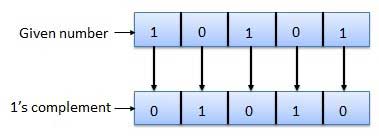
1's complement

The 1's complement of a number is found by changing all 1's to 0's and all 0's to 1's. This is called as taking complement or 1's complement. Example of 1's Complement is as follows.

1's complement

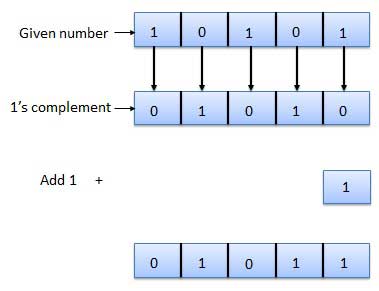
2's complement

The 2's complement of binary number is obtained by adding 1 to the Least Significant Bit (LSB) of 1's complement of the number.

2's complement = 1's complement + 1

Example of 2's Complement is as follows.

 2's complement


Decimal system complements

 In digital logic, decimal complements are employed less frequently than their binary equivalents. The majority of contemporary digital systems rely on binary representations and complements, such as 2's complement, for effective arithmetic operations, even if they still have some historical relevance and few uses.

Below is a summary of the various decimal complements:

1. Ten's complement, or Radix complement:

  •     found by deducting each number from nine.
  •     Example: 999 - 375 = 624 is the ten's complement of 375.


2. Nine's Complement, or Diminished Radix Complement:

  •     found by deducting each number from eight.
  •     Example: 888 - 375 = 513 is the complement of 375, which equals nine.


3. The Complement of (R-1):

  •     Reversed each digit from (base - 1) to find.
  •     For instance, the complement of 375 in (9-1) is equal to 888 - 375 = 513 in decimal notation.

Uses:

  •     used for subtraction in mechanical calculators in the past.
  •     utilized in certain applications of some circuits for decimal arithmetic.
  •     A setting for education in order to comprehend complements.

Restrictions:

  •     more intricate computations in contrast to binary complements.
  •     Need more circuits to handle overflows and carry.
  •     Not effective for big values because to possible overflow of digits.

Decimal vs. Binary Complements:

  •     Because binary complements—ones and twos—have more uses and are easier to implement, they are utilized more frequently in digital logic.
  •     With binary complements, representing negative values and carrying out arithmetic operations are more effective.

Latest Notifications

More

Results

More

Timetables

More

Latest Schlorships

More

Materials

More

Previous Question Papers

More

All syllabus Posts

More

AI Fundamentals Tutorial

More

Data Science and R Tutorial

More
Top